An In-Depth Analysis of the Photography of the Artist Reem Al Faisal Al Saud, Haitham Fathallah
Undoubtedly, photographs provide a realistic, vivid chronicle of a place at a unique moment, one that will never be repeated. Recording that instant within a frame is a documentation of a place and time, and a social snapshot of those who appear in it.
The photograph remains an immortalised moment in history, with all its feelings, emotions and variables coupled with artistic implications. The objective of a photograph is to present a work of art with human emotions, along with a touch of undeniable beauty, visual elements that indicate motion and give insight into day-to-day life. It is a document that will accumulate the memories of life's social relationships and convey a vital message to the person receiving it.
Photographs stir human emotions, rousing memories and feelings – particularly if in-depth thought is present in the frame, coupled with the beauty of light and angle. All of these combine to reach the viewer and enrich their visual culture.
Photography is intricately related to the photographer's inner feelings. It is the photographer who produces the creativity of the photograph, from darkness to shadow to light, along with the actual subject. The photographer is an artist who inspects the elements of reality and the variables of life to document a unique instant that could be missed by a casual observer.
When an artist looks through the lens of their camera, an entire visual creation results and an image with vernacular philosophical sentiments and an existential intellectual interpretation is formed.
The relationship between man and space is eternal, and his movements and gestures are closely ttached to his surroundings. Consequently, when a photographer frames an image containing the duality of man and space, while considering the technical distribution of darkness, light, and everything in between, the resulting aesthetic elements burst with feeling and are full of affection.
Such a photograph is the product of a mind in tune with human emotion and an artistic sense of creativity.
From this point, we enter the world of Saudi artist Reem Al Faisal Al Saud’s photography, viewing her work in terms of the duality of contrast, the relationship between darkness and light, and the angles of perspective, as well as the human, emotional relationship between her and the viewer.
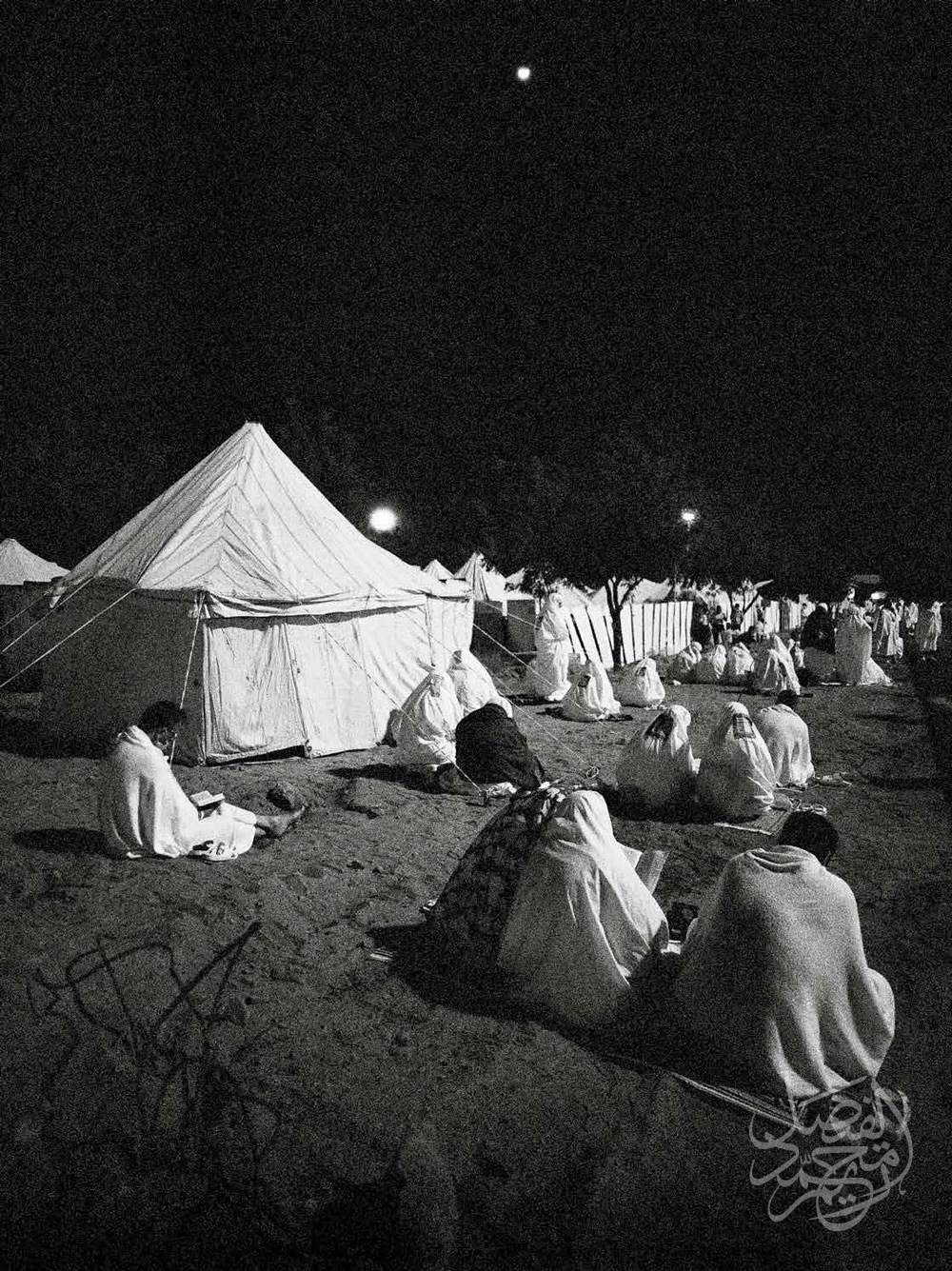
Light between Shadow and Darkness
Photographers use the duality of shadow and darkness, which are born from light, to artistically express reality and the various components that make up life.
Light – or the Light of God, as Reem Al Faisal Al Saud likes to call it – is a heavenly ray that evokes joy. It is part of the photographic narrative because it makes indistinct angles appear and embodies them as part of the visual frame. Darkness is merely a contrast to light; however, it highlights the day-to-day objects that appear in the image, placing them within a specific holistic, visual creation. Shadow, ultimately, remains the artistic element that accentuates the angle of the shot and achieves an overall visual balance between light and darkness.
Reem Al Faisal Al Saud’s picture of pilgrims sitting on the ground in front of their tents on a night with a full moon embodies the duality of darkness and shadows, emphasising man’s reverence for his Creator by splitting the space in two. She presents the upper part of this image as a symbolic expression of the presence of God Almighty, done in complete darkness. The clarity and purity of the night sky underscores the philosophical relationship between God’s presence and man, sitting on the ground in the lower half of the image, worshipping in the gleam of light emanating from the heavens above.
The choice of this artistic perspective not only captures human life at that very moment but invites an association with shelters, invoking the traditional Arab tent as part of Arab Bedouin heritage. Also, she disconnects the foreground from the background, emphasising the magnitude of the humanity in this place as the pilgrims read the Book of God. The symbolic expression of the link between the human soul and the infinity of the sky is characteristic of the artist’s understanding of life and the sanctity of a person’s loyalty to their religion. Consequently, this photograph becomes a means of documenting life in light of a social phenomenon that reflects the intellectual and artistic side of visual creativity.
In another expressive photograph taken at night, of the Grand Mosque in Mecca, the mixture of light with shadow and darkness in a homogeneous and interlaced manner makes it difficult for us to differentiate between them. Here, Reem Al Faisal Al Saud succeeds in giving the overall image a harmonised grey colour, intentionally emphasising the Holy Kaaba with its dark cladding, surrounded by thousands of worshippers. The angle of capture, with all its intelligence, highlights the minaret of the Grand Mosque nobly overlooking the worshippers from the other side, as if chanting the name of the Most Merciful. The power of this configuration lies in the innumerable worshippers outside the Grand Square, who subsume the roads and alleys, with the buildings in the background seemingly void of life. Life is embodied in the crowds and their awe around the Holy Shrine, highlighting the artist’s creativity in placing her intellect in a location that has a history and a reverence to God Almighty, and allowing it to be biased towards it while simultaneously radiating true rationality and objectivity.
In her photograph of the Prophet’s Mosque, Reem Al Faisal Al Saud displays the spirituality of the dark sky and the shadows over the domes and minaret in the foreground. In this photograph we see a number of phenomena: the immense darkness of the sky dominates the entire perspective, indicating the power of the Creator, while the halo surrounding the minaret radiates the sanctity of light as it shines with the spirituality of the place. Focusing on the two domes without showing more details strengthens the symbolic connection to place, calling attention as it does to a specific aspect of Islamic architecture. The modern structures in the middle ground of the photograph indicate the presence of a modern city coexisting with the inherited Islamic religious ideas and architectural creations. From a photography perspective, Reem Al Faisal Al Saud succeeds in presenting both extreme darkness and extreme light. Applying the zone system – a grading method that measures the degrees of light and darkness from white to black in all areas of an image – to this photograph reveals that the shades of grey are distributed in an elaborately artistic manner, expertly highlighting the features and capturing the viewer from their first glance.
From this photograph we can feel Reem Al Faisal Al Saud’s ability to enter the day-to-day battle as a woman. By focusing on the cloistered, religious life of this scene, she first philosophises on the subject and its various components, and then depicts it with her artistic lens in an image that is not only unique, but also full of humanity and reverence to the Light of God. Ultimately, Reem Al Faisal Al Saud’s work gives us stories and images we are proud of, religious inheritances that are closely linked to Islam and that can be presented to the West as part of our Arab, Islamic heritage through our worship of God Almighty.
Space in the Photographs of Reem Al Faisal Al Saud
The conscious photographic artist observes the places related to daily life. Such settings give a philosophical quality to the image, linked as they are to the toil and effort that man makes on a day-to-day basis. They also denote the role of the innate attraction between place and man in establishing social relationships, whether these are with one person or within a group living in harmony in the same place. A place invites visitors to gaze at its aesthetic attractions, which may be natural or constructed, and then becomes a dormant image in the human memory. And if the place is associated with intellectual, ethical and social components with links to the nature of history and its repercussions, then it will possess the mind with a strength linked to this history.
Here we find some of the images captured by Reem Al Faisal Al Saud that focus on place and its identity, confining the human element within spatial determinants that make it a part of this reality, linked to both time and place.
In a photograph taken in a mosque in Istanbul, Reem Al Faisal Al Saud has dedicated eighty per cent of the area to place and depth, from the darkness to the arches and their varying degrees of shadows, in an attempt to capture the image of a man as he seeks forgiveness from his Creator. At the same time, she shows the living being as a small element of the holistic concept of the image, thus displaying her belief that place is the dominant aspect and the human being is only a part thereof. Reem Al Faisal Al Saud’s photographic curiosity and the clever perspective, combining shadows and lights, allow the darkness to strengthen the human and spatial components of the photograph, especially the heaven-sent light emerging from one side. The result is an image with a wonderful colour contrast.
Reem Al Faisal Al Saud underscores how small human beings are in the face of nature and all that surrounds them. In one photograph, for example, she places a being, weary with age, as he looks at life through a narrow opening, between a dark arch and a flat ground. This divides the picture into two major elements, one that is completely dark and another that has hope and life, despite the passage of the years. The philosophical and formative aspects of this photograph succeed brilliantly, showing that humans search for what is missing in their lives, to be found only in the surrounding shadows of the image after night has fallen. This is a metaphorical expression.
that the viewer will be able to see amidst the beauty of the image and its subject.
In another picture, Reem Al Faisal Al Saud’s eye worked with her lens to enhance the presence of place in the individual memory, reflecting it on the self with an aesthetic movement that shows its strength while holding the place in a contemplative gaze, searching for the joy of spatial existence. The viewer, when seeing this photograph, will observe a space in the form of an elegant architectural element where darkness and light harmoniously highlight the power of the artistic perspective of the photographic composition, which is limited within the boundaries of the shadows of the dark entrance, its harshness broken by the upper window, giving the composition another dimension.
The debate on existence is recognised here as being dependent on the relationship of man to place, and Reem Al Faisal Al Saud’s photographs tell the story of places that reflect the interaction of the human soul with his physical existence.
The Beauty of Emptiness in Reem Al Faisal Al Saud’s Works
Emptiness is eternal loss that has no limits. In certain circumstances, human beings will find themselves mentally removed from material existence. This form of mental or psychological relaxation that allows us to put aside the burdens of life is embodied by Reem Al Faisal Al Saud’s photograph of a boat in a solitary sea, in a moment of complete calmness and serenity. This is evident in the homogeneity of the horizon and the sky, which form a single perspective that surrounds the boat, allowing its occupant a contemplative retreat to restore the joys of life. In this photograph, Reem Al Faisal Al Saud links the components of creation – heaven, water and man – with the secret of life: “We made from water every living thing” (Surat Al-Anbiya, verse 30).
Linking life to water in another scene, Reem Al Faisal Al Saud photographed a camel in all its glory and grandeur as it strode alone along a beach – not the natural environment of the animal we know as the ship of the desert. She confines the creature to an artistic perspective at the bottom of the scene, leaving a large expanse of sky and water to signify the manifestation of God Almighty on all spheres of life, regardless of their subject matter, alluding to the greatness of the Creator, the Almighty.
In another photograph, Reem Al Faisal Al Saud minimised the size of the living being before the greatness of the sky, the earth and the sea. Allowing the camel riders only a small part of the frame gives perspective to the beauty and purity of the sky. As we view this scene, we can almost hear nature telling us that living beings pass by quickly on their journey of life, whereas the waves of the sea are fully capable of erasing all that humans leave behind if their existence is not rife with creativity and manifestation. This sophisticated view, comprising life precepts and principles as it does, compels us to stand before Reem Al Faisal Al Saud’s photographs and gaze at all their angles and perspectives, whether they are related to humanity or to life in general, and to take in the beauty of nature.
In a photograph of two people on their bicycles, each facing a different direction, which was taken in Morocco, we see that the man on the left is leaning against a wall and watching the waves in an attempt to wash away the burdens of a tiring day, his work gear and clothes packed into his basket, while the person approaching from the opposite direction is overcome by the feelings of the first. It’s obvious that this photograph was shot at dusk, giving us a complete side shadow of the figure on the left, offering a new dimension of beauty. Again, we see here the dominance of the sky, which occupies a big area. And once again, Reem Al Faisal Al Saud stresses the link between humans, the sky and the earth in all parts of the world, even when people’s paths go in opposite directions.
The Portrait
Embodying faces via portraiture is another form of photographic art, encompassing the depiction of a person’s characteristics with creative distribution of shadows and light. It is also a reading of the subject by the photographer, revealing the human expression hidden in the soul of the person sitting before the camera. All of this often occurs in a scene that is prearranged in order to capture a single moment.
In this regard, Reem Al Faisal Al Saud has a different concept. Rather than taking pictures of a person on his own, she prefers to capture an image of a homogeneous group of people, at the same time singling out an individual who, seen through her lens, almost appears to be the only person there. This allows Reem Al Faisal Al Saud, with her piercing eyes and enlightened mind, to document that moment in time when the person’s eye meets the lens, silently and with surprise. The subject is unaware of this documentation, allowing the image to appear spontaneous but with an intensity that attracts the viewer to the focal point, forgetting all the other details that appear in the image.
The photograph of an African woman looking into the camera spontaneously and critically, in contrast to the other women, shows Reem Al Faisal Al Saud’s focus on the clarity and accuracy of the eyes. The manipulation of the depth of the lens, the highly successful choice of angle, and the perfect timing of the shot give her subject artistic value as she stands among others who blend into the background of the photograph, allowing her character to stand out through the balance between black and white, as if she were saying to the camera I am here! This photograph displays the symmetry between the nature of an individual’s reaction and the impact of spatial elements.
In another photographic dialogue, Reem Al Faisal Al Saud stands within a group of people, capturing Louis Farrakhan’s hidden, private smile with her camera lens. The photographer uses shadows to reveal Farrakhan’s character and make him the main subject of the picture, while the light descending from the side illuminates the joy on his face. Here, darkness and light are once again in harmony, creating colour pairs between black and white that Reem Al Faisal Al Saud confines to a central circular area, allowing her subject to be highlighted with ultimate transparency in the midst of the darkness that surrounds the image.
In a witty snapshot taken during Hajj rituals, a woman carries silk gifts on her head. Reem Al Faisal Al Saud allows her subject to fill the entire image, her white clothing an expression of the purity and virtue of religious feeling, while her face simultaneously expresses joy and happiness. Although the image has very few details, these are nevertheless intriguing due to the intellectual depth that is apparent, proving the artist’s ability to move with speed to spontaneously capture a moment in time. This is a characteristic of a photographic artist, paying attention to everything that is happening around them relevant to man and life in order to capture the details in terms of time and place, ensuring they remain a documentation of a religious and worldly social reality and a record of events that future generations can benefit from when studying our times.
Conclusion
When conducting a thorough reading of Reem Al Faisal Al Saud’s works, we find diversity in the subjects of her photographs. She attempts to portray human feelings in most of her images, along with the historical, artistic architecture of Arab and Islamic culture.
Reem Al Faisal Al Saud has a very strong visual culture that she has developed with the bravery possessed by a woman living in a conservative, closed, male-dominant society – a society that she has penetrated with her trained intellect and her feelings towards her community. She succeeds in using her lens as a means to express and record her memories of day-to-day life, which have been residing in her imagination since she was a child. She documents these now, at a later stage in life, in the form of photographs stemming from the heart of people’s lives, and presents them to local, Arab and Western societies alike as a record of life’s struggles on a global scale.
Reem Al Faisal Al Saud never stepped into the world of colour photography. She continues to search for darkness in the framework of her photographs in order to lighten it later with her lens, choosing different angles and perspectives to help her reveal her chosen subjects in black and white, highlighting them as the main theme of the visual scene. This captures viewers’ emotions and urges them to question the image realistically, artistically and philosophically.
Reem Al Faisal Al Saud has access to the private systems of Arab women’s daily lives: because she is a woman, she is able to reveal many of the customs and traditions that are practised far from the male eye. Her intense documentation of these women’s lives and places is coupled with an artistic perspective and spontaneity, depicting darkness between the shadows and the light to give us images that speak with an aesthetic and objective tone.
Reem Al Faisal Al Saud’s travels to various capitals in the West have given her immense freedom to examine the components of life in different societies. This has provided her with a vast database that contrasts with her life in Saudi Arabia, motivating her to highlight the human aspects of her world which the West is unaware of, due to the closed-off nature of Saudi society. This is especially true of the rituals of Hajj and Umrah, which she visually documents in an environment full of love, peace and reverence. Reem Al Faisal Al Saud has succeeded in presenting a positive image of a society that is committed to the teachings of its religion. As part of her travels, Reem Al Faisal Al Saud tries to show us how her lens, and her piercing eye, has been affected in order to compare the behaviour of westerners and easterners in the streets and alleyways of holy places. She also depicts urban and architectural aspects, whether old or new, and links these to the people in and around them, offering a compelling documentation of the reality of life in these cities.
Additionally, Reem Al Faisal Al Saud strives to offer images that are sometimes theatrical and even exhibitionist in nature by repeating documentation shots from one angle, limited both by the movement on stage and by the lighting. This forces her to take the picture again and again with the same spirituality, differing only in the movement on stage. Reem Al Faisal Al Saud succeeds in some cases, but the scene repeats itself in others, giving it a weakened visuality and a restricted framework. This is a method that the artist should avoid, as it is limiting to her photographic skills.
Reem Al Faisal Al Saud seemingly carries her camera with her everywhere she goes, offering a documentation of everything that passes before her eyes – documents of time and photographic fact. Her targets are firstly the human, and then the places and their surroundings. However, she sometimes captures images for the sake of snapping them, losing the photograph between concept and goal. Doing this allows her the final word in choosing what she wishes to reveal in her photographs, in line with her philosophy on life, thus continuing her mission of offering us her vision within a cultural concept.