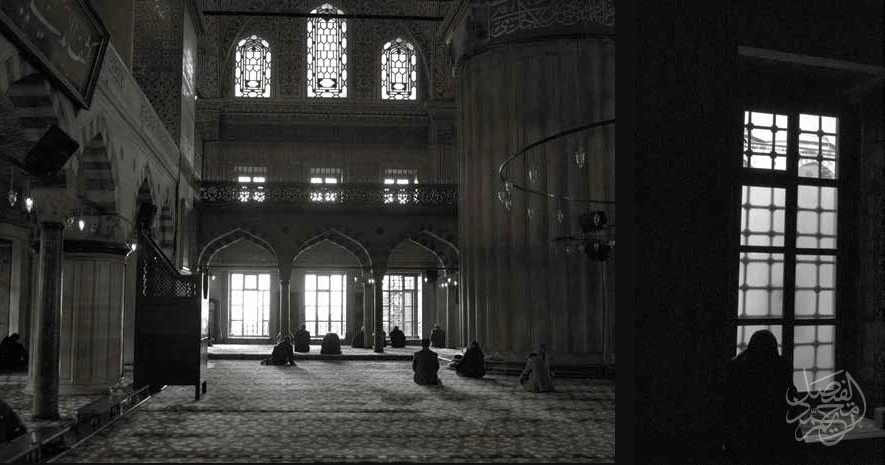
The musicality described here by Henri Alekan seems to take shape in this image, the light acts as a filter to dialogue silently with the men bending to the divine. The shadow preserves them from the tangible, keeping at its heart the secret of their faith. Likewise, a woman dimly lit by the faint light from a window seems to engage in private prayer. In this photograph, Reem Al Faisal Al Saud makes the silent power of meditation shine through. All the beauty of the images rests on subtle exchanges between light and darkness. These values intermingle, the fluidity of the light and the transparency of the shadow translating the inexpressible sound of meditation. Some spiritual magic happens in these places of worship.
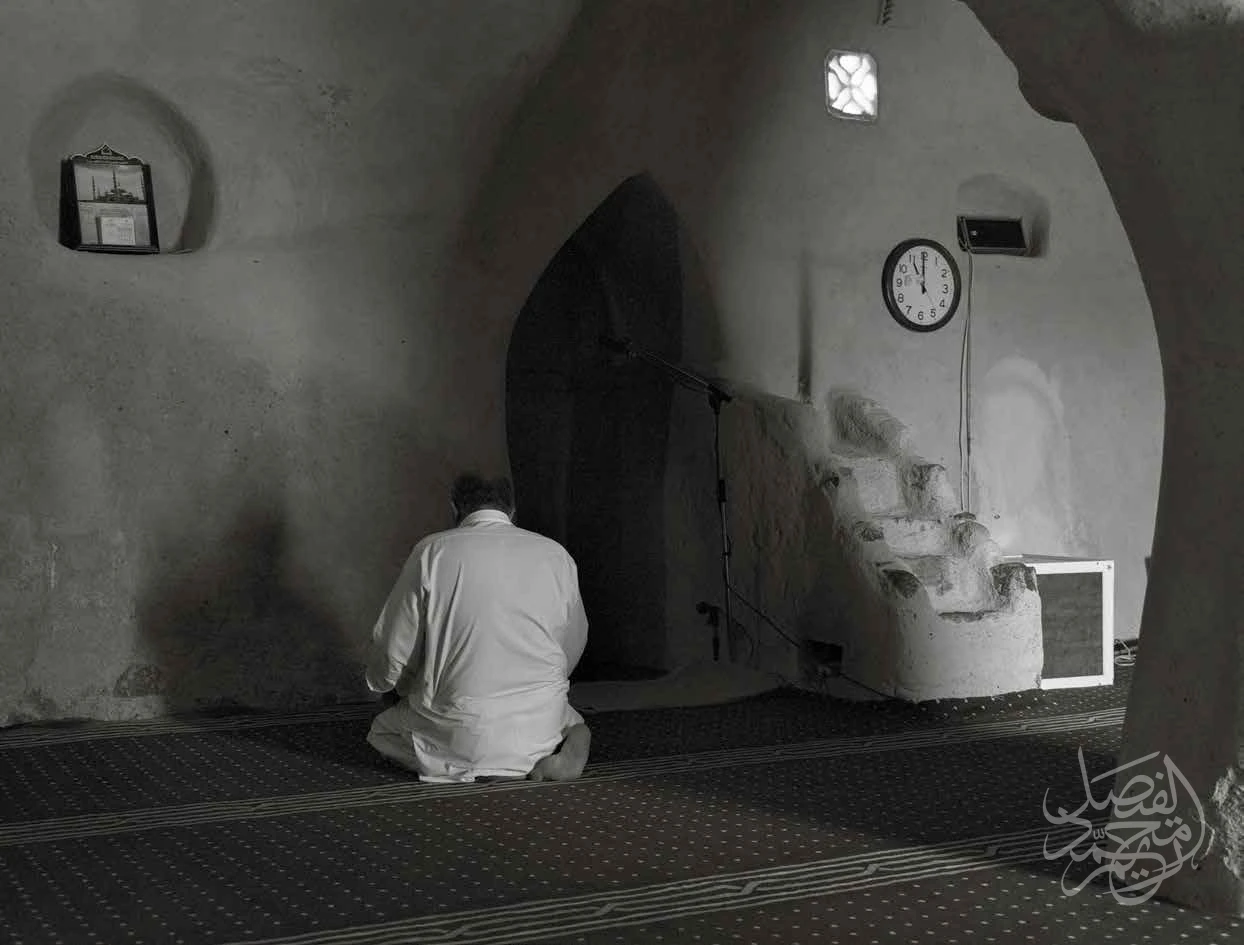
“Black and white is metaphysical. It gives you the metaphysical side of art. People can get distracted by color and forget about the image itself, but a black-and-white photograph forces the people to focus on the image,” Reem Al Faisal Al Saud explained in an interview.5 This metaphysical aspect is also visible thanks to the timeless nature of black and white. The absence of colour creates distance to the viewer. The depth of the blacks expresses the ineffable resonance of the soul. Colour could not have expressed this intimate and secret gesture. In fact, these prayer photos express Reem Al Faisal Al Saud’s feelings: “the prodigious work of opening thesoul”,6 the life being lived in the pictures. Here emotion is photographed, as with this man seen from behind. His graceful gesture, the folds of his shirt, the aerial shadows, the curves of the alcove: all these elements echo the solitude of the man and his piety. In comparison, we are struck by the clarity of the images from the pilgrimage, where men and women are all dressed in white, thus translating the radiance of faith. Darkness is for contemplation; brightness is for the journey to the Holy Land. Each time, respect is the essence.
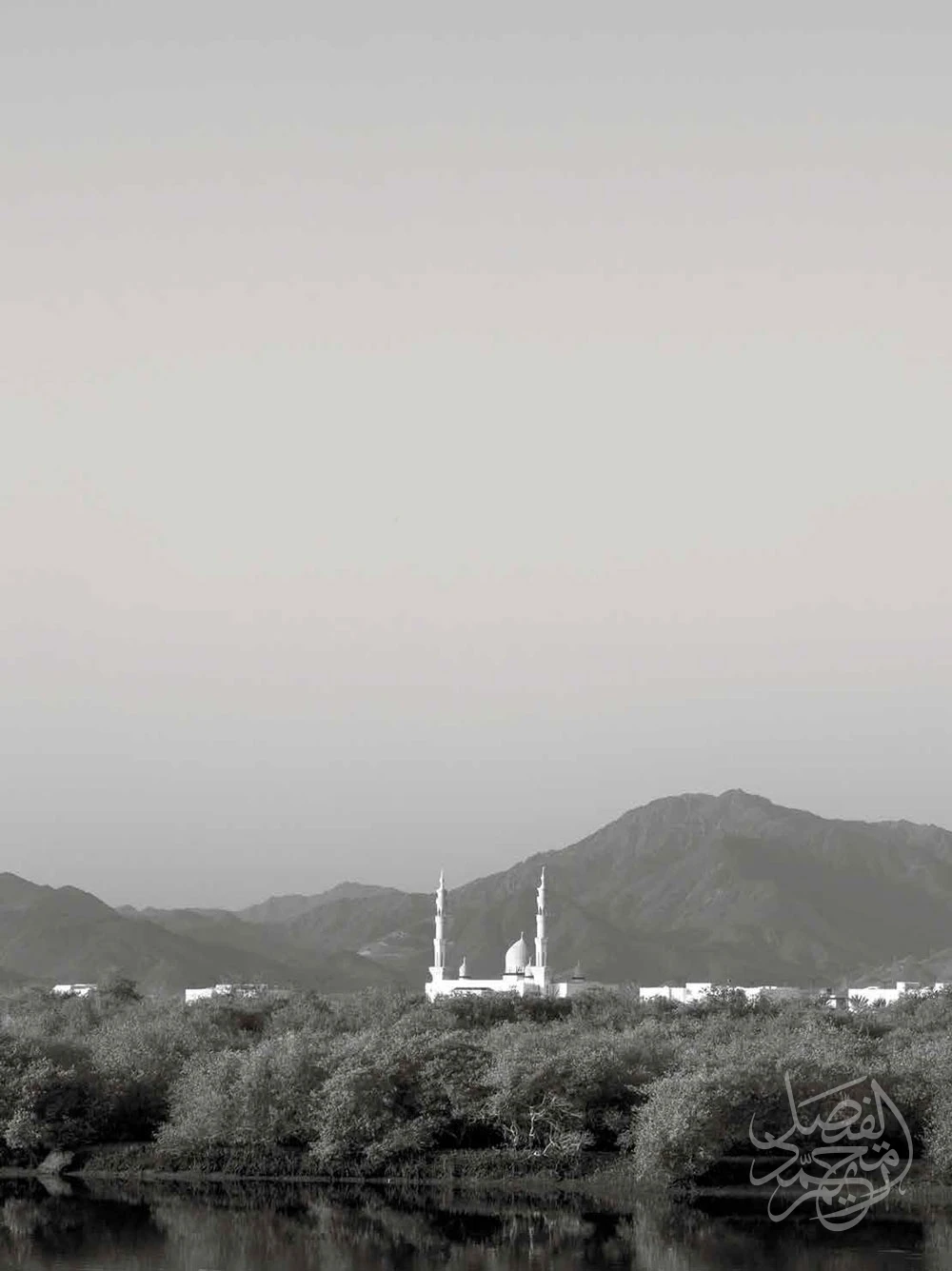
 Reem Al Faisal Al Saud finds inspiration in nature, in what the soul conceals between heaven and earth. She then recreates in her photos a world of her own, a world she can share. This impressionistic dimension is also present in her landscape pictures. The views of Fujairah are reverse images of the enclosed universe of prayer. Space unfolds. Some photos are built on a simple but assertive basis. Horizons are low, the omnipresent sky recalls the divine presence. As in the images of places of worship, a touch of light sometimes appears; the sun, the moon or a simple street lamp shows up discreetly. The blacks are softer and more subtle. The mosque in the Ras al-Khaimah area rises majestically in the middle of nature, like a jewellery box between heaven and earth (see p. 24). The gentleness emanating from this picture calls to mind the impressionist hues of Gustave Le Gray’s landscapes.
The notion of landscape refers to the philosophical conceptions of the human being within the world, of finitude versus infinity. Moreover, the land stretching in front of our eyes makes us more aware of ourselves. When we contemplate a landscape, time freezes and gives way to meditation. The photographed space is projected within us and reveals not only the splendours of nature, but also our floating souls. “Dreams come before contemplation. Before becoming a conscious sight, every landscape is an oneiric experience. Only those scenes that have already appeared in dreams can be viewed with an aesthetic passion. … But the oneiric landscape is not a frame that is filled up with impressions; it is a pervading substance.”7 According to Gaston Bachelard, the landscape’s oneirism awakens the matter, and in this materiality of the landscape lies the image we make from it.
Reem Al Faisal Al Saud’s palette of greys draws the contours of a dreamy landscape. These subtle shades, neither totally black nor deeply white, give the landscape a pictorial quality close to that of a drawing. In this poetic in-between, the contemplation of the landscape awakens complex sensations, the whole range of perceptions we keep inside us. The soothing silence of the place, the sharpened roughness of the mountains, the bubbling confusion of the palm trees, the delicate smell of the sand, the airy delicacy of the clouds: all of these remind us that we are alive.
From its very beginnings the art of light par excellence, photography constructs a visual world that expresses itself between two extremes: black and white. “To me, black and white is the highest level of photography, and it gives you depth and symbolism that don’t exist [with colour pictures]. … It has a deeper philosophy which is that life itself has degrees of grey.”8 In Reem Al Faisal Al Saud’s images, these characteristics of black and white translate our relationship to the world: between dusk and dawn, the photographer’s eye gives us food for thought.
(Translated from the French by Aurélie Lacouchie)
