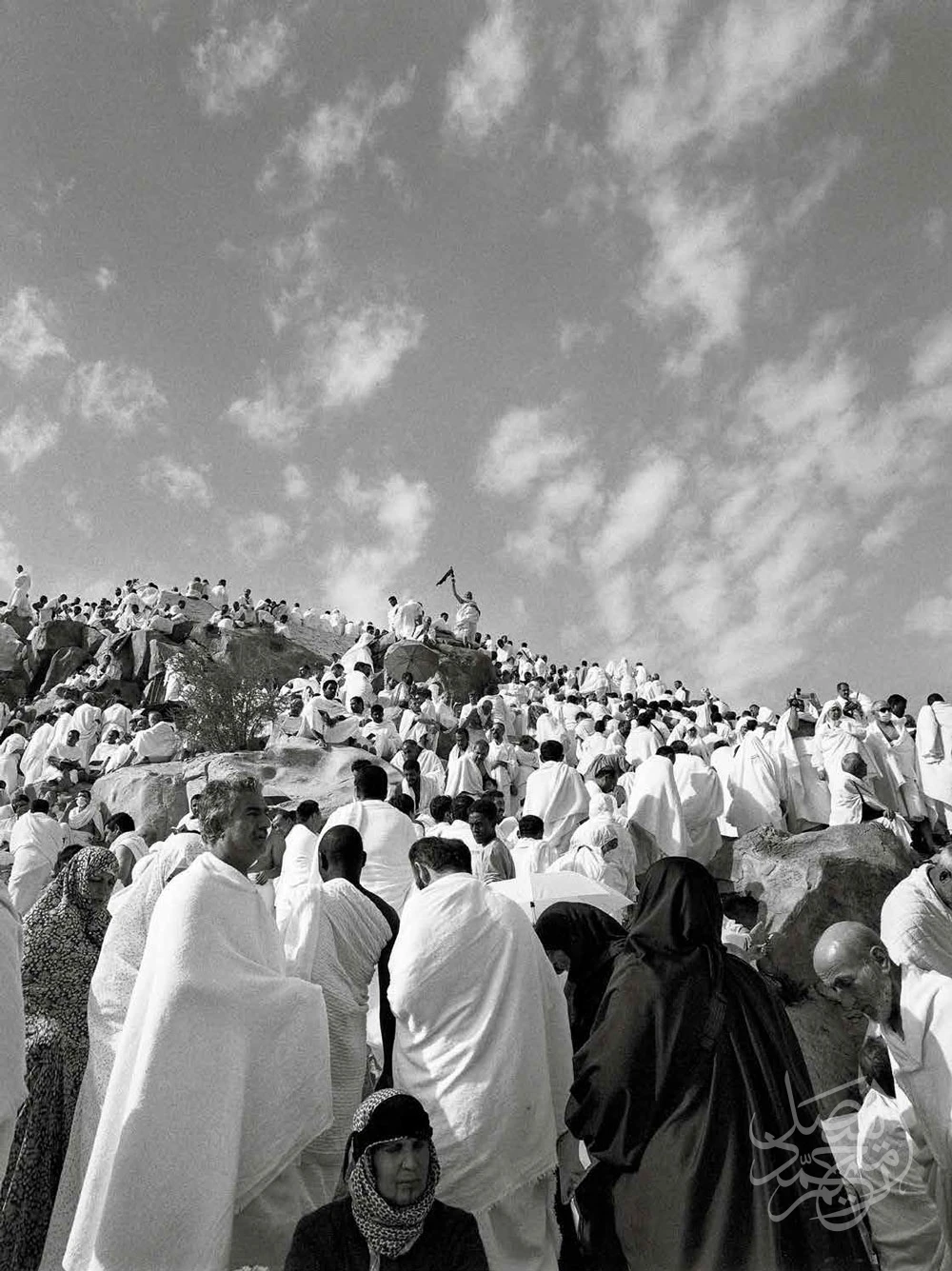
These shots are parts of a broader documentary series of the Hajj that Reem Al Faisal Al Saud created from 1999 to 2003. It remains her most celebrated work and places her among the very few women to have covered this annual event that is an obligation for Muslims. In the twentieth and early twenty-first centuries, the Hajj witnessed considerable growth, from less than 60,000 foreign pilgrims in 1920 (AH 1338) to nearly 2 million foreign and over 600,000 local pilgrims in 2019 (AH 1440).6 Then and now, the pilgrimage has been experienced as an extremely intense emotional shock, the “consciousness of infinite happiness”.7
When he reached Medina, a pilgrim from Algeria wrote of a “magnificent and dazzling vision”, adding: “my joy was so immense that I found myself, surprised, chanting the praise of the Prophet.”8 In the first paragraph of his “Letter from Mecca”, Malcolm X wrote, “Never have I witnessed such sincere hospitality and the overwhelming spirit of true brotherhood as is practiced by the people of all colors and races here in this Ancient Holy Land, the home of Abraham, Muhammad, and all other prophets of the Holy Scriptures.” The African American leader and human rights activist was sensitive to the fact that “there were tens of thousands of pilgrims, from all over the world. They were of all colors, from blue-eyed blonds to black-skinned Africans. But we were all participating in the same ritual, displaying a spirit of unity and brotherhood that my experiences in America had led me to believe never could exist between the white and non-white.”9 Half a century later, Reem Al Faisal Al Saud confides that even though she was more familiar with the Hajj than the authors of these testimonies, having been born and raised in Saudi Arabia, this immense gathering that encompasses human beings from all over the world is overwhelming for her as well: “It is an experience which has changed my vision of the world and of myself.
 I was able to gain great insight into the human psyche and racial differences. It allowed me to gauge both my physical and mental abilities. Other than being in a war zone there is nothing more strenuous than the Hajj.”10 Al Faisal’s Hajj series comprises pictures taken from various points of view and distances from the subjects. They can be roughly divided into three categories: the aerial and distant views, the medium shots and the close-ups. The aerial and distant views are extremely spectacular for any observer, even if they don’t know anything about the Hajj or about photography. It is impossible not to be impressed when viewing the “city of tents” in Mina, where more than one hundred thousand airconditioned structures have been assembled to accommodate the hajjis, constituting a rhizome of pointed constructions that cover the plain to the sharpened Hejaz mountains in the distance. A similar sensation emerges from the bird’s-eye view of the Masjid al-Nabawi – Prophet’s Mosque – in Medina, where the structure, immense as it may be, doesn’t look big enough to sufficiently accommodate the crowds. Still, the apotheosis of this photographic genre is Al Faisal’s photograph of the Masjid al-Haram – the Grand Mosque – in Mecca at night, shining like a diamond with its minarets, cupolas and, of course, the Kaaba. The author of these iconic shots admits that “it is difficult to capture the Hajj in text or visually since the Hajj is larger than any possible description. No book or photograph can ever give the Hajj its due. Even those who perform the Hajj can never fully comprehend it.”11
While the panoramas require the photographer to be physically distant from her subject, the medium shots and close-ups are necessarily taken from within the crowd. They disclose individuals whose faces emerge from the multiplicity: woman in profile, her eyes closed, her facial features tense, carrying a bag on her head (see p. 16); a man facing the camera, behind him a white textile background that reveals his wrinkles as precisely as if they had been drawn in ink by a calligrapher. Like all the participants, the photographer has to be extremely cautious. Any human mass can by emotionally draining and physically perilous, and here everyone is exposed to the risk of “constant rush and hurry, waiting, congestion and holdups, fear of getting lost and claustrophobia”.12 Reem Al Faisal Al Saud is more than conscious that “in the Hajj, humanity itself becomes an obstacle. You are in a river and sometimes you are really swimming against the tide. A lot of times you can get crushed. On many occasions, you have to just drop out of the way. The crowd has its own logic. You really have to be on the edge.”13 While these challenges apply to all hajjis, being a photographer – and even more, a woman photographer – makes things more complicated. Al Faisal remembers being told by pilgrims travelling from Mount Arafat to Muzdalifah that photography was sinful, and even having pebbles thrown at her. “Thank God they were small stones,” she says. “I have faced people who cursed me and I have faced people who wanted to hit me.”14
 These challenging conditions haven’t prevented Reem Al Faisal Al Saud from the pleasure of photographing the crowds. Her pictures emerge from this colourful, lively mass of humanity and its expressions of faith, tenderness, focus, love, fatigue and extraordinary energy. Baudelaire’s fascination with the crowd, as a spectator of the world, comes to mind:
For the perfect flâneur, for the passionate spectator, it is an immense joy to set up house in the heart of the multitude, amid the ebb and flow of movement, in the midst of the fugitive and the infinite. To be away from home and yet to feel oneself everywhere at home; to see the world, to be at the centre of the world, and yet to remain hidden from the world – such are a few of the slightest pleasures of those independent, passionate, impartial natures which the tongue can but clumsily define. The spectator is a prince who everywhere rejoices in his incognito.15
Similarly to her father, the late Mohammed bin Faisal Al Saud, Reem Al Faisal Al Saud has travelled extensively around the world on her quest to take pictures from a “stranger’s perspective”. It was in 1992, when her aunt, Princess Haifa, whose husband, Prince Bandar Bin Sultan, was Saudi Ambassador to the US at the time, commissioned her to take pictures of Saudi Arabia, that photography changed from a hobby to her lifetime occupation. Al Faisal soon became both the first photographer and the first woman to enter Jeddah Port.16 From this time onwards, she constructed herself as a social documentary photographer with an interest in forceful events, like the Hajj, and in life’s simple moments. In a photograph taken on the outskirts of Jeddah at night, a woman and a young man are seated on the carpets, playing carrom (see pp. 178–179). The woman is focused, gazing through her glasses at her hands, which are swiftly manipulating the carrom men. The young man’s facial expression reveals a smile with a bit of tension. His right arm is blurred, as it is moving. The scene takes place in a rest and leisure area. In the background, other people are seated on chairs, conversing with each other. Another shot, probably from that same evening, depicts an elegant woman seated on a cushion before a fire, a wide smile on her face. Around her are seated children and to her left a man holds a reflex camera, his face turned in the opposite direction, where people are sitting around tables. These are moments of tenderness in the lives of human beings.
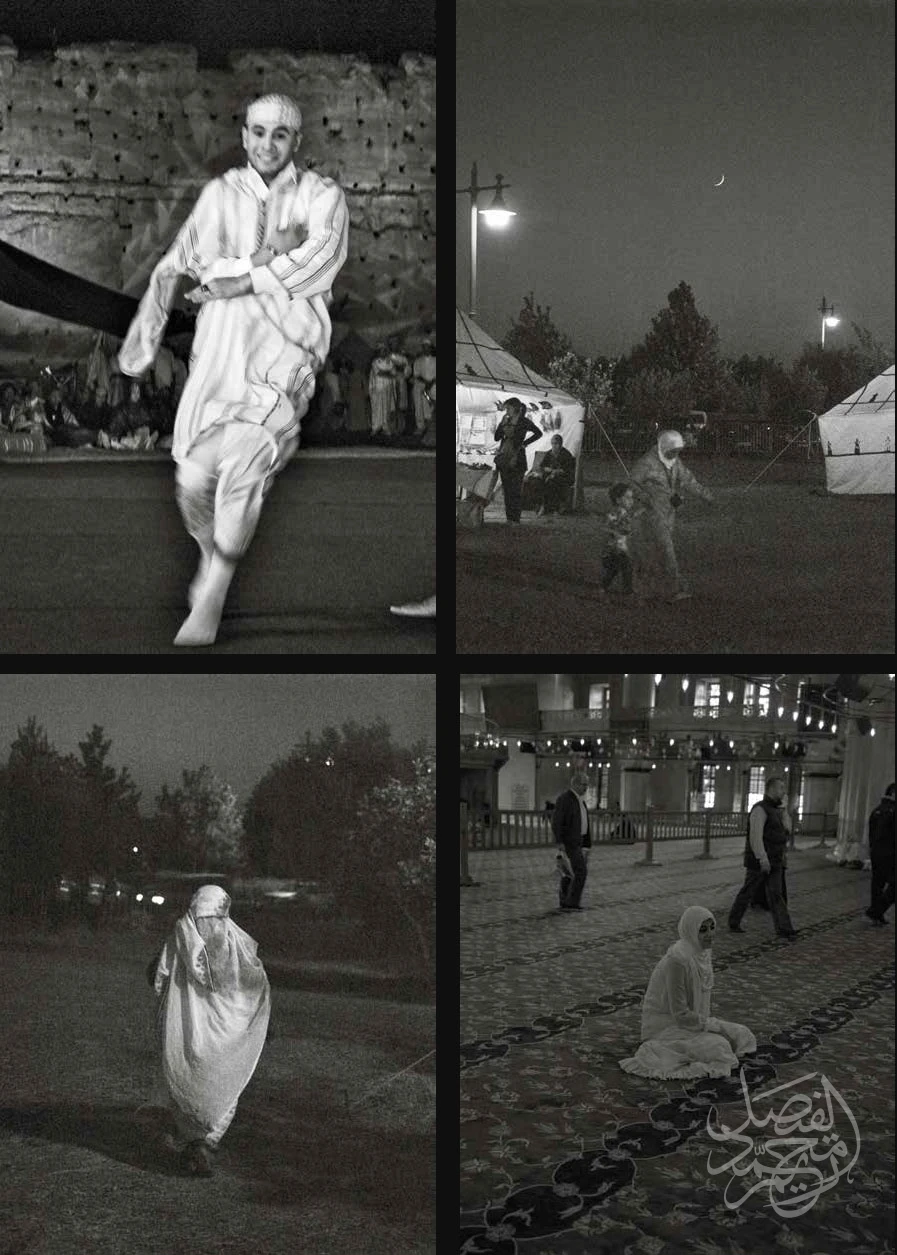 TThe smiling lady is strikingly analogous in her posture to a young woman in another photograph, also seated on a cushion, or perhaps directly on the ground, at night in an exterior, surrounded by two elderly people (see pp. 128–129). The young woman’s gaze is focused on something or someone, as her chin rests on her left hand. This chiaroscuro scene is part of a documentation of the National Festival of Popular Arts in Marrakech in 2012. Beyond the performative aspect of the event, which features songs, chants and dances from various regions of Morocco, the photographs convey movements and expressions with profound generosity. A man fluidly dances or runs, the dynamism of his body as it leans towards the right contrasting with the massive ancient walls of the El Badi Palace in the background. A girl looks with intensity at the camera during a daylight masquerade (see p. 21), displaying the henna drawings on her face amongst a feast of costumes and accessories. Al Faisal also conveys ordinary actions and gestures, like a woman walking with her child under the crescent moon and another moving calmly towards the trees, her back to the camera. This same kind of loneliness emanates from a woman seated on the carpets of Istanbul’s Sultan Ahmed Mosque, or Blue Mosque. Though other figures are present, including two men behind her, one standing and the other walking, the woman is by herself, smiling. The softness of her clothing and the airiness of the light provide a remarkable sense of serenity. In this case, as with many other shots, including street scenes taken by night in Tunis, the choice of black and white is essential.
Numerous photographers, especially documentary photographers, still consider black and white the most noble rendering, in the tradition of historical practitioners such as Henri Cartier Bresson, René Burri and Marc Riboud. “Black and white is metaphysical,” says Al Faisal. “It gives you the metaphysical side of art. People can get distracted by color and forget about the image itself, but a blackand- white photograph forces the people to focus on the image.”17 The architecture, the light and the atmosphere of Sultan Ahmed Mosque provide the perfect setting to express this metaphysical aspect. Seen in backlight, a group of worshippers seated under the arches and stained-glass windows belongs to the moment the picture was taken, as Cartier Bresson defined “the decisive moment”, but also to eternity. When the camera turns upwards and catches the light entering through the openings on the drum of the cupola, towards the sacred inscriptions and the Iznik ceramic tiles, the viewer is captivated by the magnificence of this edifice that has been praised since its construction by locals and foreign travellers alike. As one visitor wrote: “No mosque can boast of such precious hanging ornaments as those of this … In short, it is a most wonderful and costly mosque, and to describe it baffles the eloquence of any tongue.”18
In Tunis, Reem Al Faisal Al Saud photographed the interior of one of the city’s numerous mausoleums. The modest size of the room, along with its pillars and flat cement ceiling, indicates that it is neither ancient nor monumental, so that it can in no way bear comparison with Sultan Ahmed. Nevertheless, the photographer conveys a tension, aided by the accumulation of images, mirrors, inscriptions, swords and flags on the tiled walls. The use of black and white eliminates the saturated tonalities – especially of the tiles – and again confers a timeless gravity. Scarcely populated, the pictures of Sultan Ahmed Mosque and the Tunis tomb provide a striking counterpoint to the concentration of human beings at the Hajj and the Marrakech festival.
At the end of the day, the photographic journey of Reem Al Faisal Al Saud is exemplary of the gazing eye of an Arab woman in the early twenty-first century. Through her travels in her country and abroad, she observes the things of the world: the people, the gestures, the tiny details, the architectural spaces. The infinity of a clouded sky and the immensity of the sea.
- Qureshi, A. Sultan, A. Rashid, M. Ali, A. Waheed, S. Manzoor, M. Baloch, S. Batool and H. Khan, “Geological and Radiological Studies of the Mount Arafat, Mekkah, Saudi Arabia”, Journal of Radioanalytical and Nuclear Chemistry (September 2012), 956–963, DOI: 1007/s10967-012-1776-0.
- This episode is relayed in detail in a Hadith by Umar ibn Al-Khattab.
- Quran 5:3.
- Dada Adelowo, ed., Perspectives in Religious Studies, iii (HEBN Publishers, 2014), 403.
- Siraj Wahab, “Art Is Not a Luxury, Says Princess Reem”, Arab News (3 April 2006).
- Sabir Shah, “Number of Foreign Hajis Grows by 2,824 percent in 92 years”, The News (25 October 2012).
- Abdel Magid Turki and Hadj Rabah Souami, Récits de pèlerinage à la Mekke (G. Maisonneuve et Larose, 1979), 25.
- Hadj Rabah Souami, “Journal d’un pèlerin”, in Turki and Souami, Récits de pèlerinage, 64.
- Malcolm X, “Letter from Mecca”, 1964.
- Reem Al Faisal, “Reem Al Faisal: El Hajj”, Nafas, Universes in Universe (October 2005), https://universes.art/en/nafas/articles/2005/al-faisal.
- Al Faisal, “Reem Al Faisal: El Hajj”.
- Roswitha Badry, “Among the Pilgrims, but Not of Them – Individualist Intellectuals on Their Pilgrimage to Mecca”, Studia Litteraria Universitatis Iagellonicae Cracoviensis, 15/3 (2020), 165–178.
- Wahab, “Art Is Not a Luxury”.
- Jumana Al Tamimi, “Saudi Princess Reem Al Faisal Makes Photography Her Career”, Gulf News (1 April 2013).
- Charles Baudelaire, “The Painter of Modern Life”, in The Painter of Modern Life and Other Essays, tr. and ed. Jonathan Mayne (Da Capo, 1964), 9.
- Al Tamimi, “Saudi Princess Reem Al Faisal Makes Photography Her Career”.
- Wahab, “Art Is Not a Luxury”.
- Evliya Çelebi, Narrative of Travels in Europe, Asia, and Africa, in the Seventeenth Century (Parbury, Allen, & Co., 1834), 113.